You Won’t Believe How Geneva’s Public Spaces Slow You Down
Geneva isn’t just about polished streets and lake views—it’s where public spaces invite you to truly pause. I spent a week moving slowly through its parks, benches, and promenades, and honestly? The city breathes differently when you stop rushing. From sunlit quays to hidden plazas, Geneva’s open spaces aren’t just pretty—they’re portals to a calmer way of traveling. This is slow travel at its most authentic. Unlike cities that demand constant motion, Geneva rewards stillness. You don’t need a tour guide or a packed itinerary to feel connected here. All you need is a willingness to sit, observe, and let the rhythm of daily life wash over you. In a world where every minute feels scheduled, Geneva offers something rare: permission to do nothing, beautifully.
The Art of Slowing Down in a Polished City
Geneva is often described as orderly, immaculate, even reserved. Its sidewalks gleam, its trams run precisely on time, and its citizens move with quiet efficiency. At first glance, the city might seem too polished for spontaneity, too refined for true relaxation. But beneath this surface of elegance lies a deeply human rhythm—one that reveals itself only when you stop chasing landmarks and start lingering. The transformation begins not with grand gestures, but with small choices: choosing a bench over a museum, a lakeside stroll over a shopping arcade, silence over sightseeing commentary.
Slow travel in Geneva isn’t about rejecting structure; it’s about redefining what matters. Instead of measuring your day by how many attractions you’ve visited, you begin to measure it by how many moments you’ve absorbed. The rustle of leaves in a tree-lined alley, the laughter of children near a fountain, the way sunlight hits the water at 4 p.m.—these become your itinerary. The city’s public spaces, carefully designed and generously distributed, make this shift not only possible but natural. They are not afterthoughts; they are the soul of Geneva’s charm.
What makes this experience so powerful is accessibility. You don’t need a ticket, a reservation, or even a map to participate. A bench by the lake, a patch of grass in a neighborhood park, a quiet corner in a cobblestone square—these are open to everyone, every day. This democratization of calm is rare in urban environments. In Geneva, tranquility isn’t reserved for private gardens or luxury hotels. It flows through the city like the Rhône River, available to anyone willing to pause and let it in.
Lake Geneva’s Promenades: Where Time Stretches
Along the shores of Lake Geneva, time behaves differently. The water stretches out like liquid glass, reflecting the sky in soft gradients of blue and gray. The promenades that line the northern edge of the lake—especially the Jardin Anglais and the Quai du Mont-Blanc—are not just pathways; they are invitations to decelerate. Here, walking isn’t about distance covered, but about presence cultivated. Locals stroll with dogs on leashes, retirees read newspapers under chestnut trees, and couples sip coffee from paper cups, speaking in low, unhurried tones.
Morning is perhaps the most magical time to walk these paths. The air is crisp, the light golden, and the city still soft with sleep. Joggers pass by with steady breath, and swans glide silently across the water’s edge. The sound of waves lapping against the stone embankment creates a natural metronome, slowing your heartbeat without you realizing it. There are no loud announcements, no crowds pushing forward—just the quiet hum of a city waking up at its own pace.
Even in the afternoon, when tourists begin to gather around the Jet d’Eau, the promenade retains its calm. You can walk for miles without feeling rushed, pausing whenever something catches your eye: a fisherman casting his line, a street artist sketching the skyline, a family feeding ducks near the edge. The path is wide, well-maintained, and fully accessible, with gentle slopes and clear signage. Benches appear regularly, spaced just far enough apart to offer privacy but close enough to feel safe and connected.
What makes these lakeside walks so effective for mindfulness is their lack of urgency. There’s no need to reach a destination. You can turn back at any point, sit for twenty minutes, or simply stand and watch the water. This freedom to move without purpose is a luxury in modern travel, and Geneva offers it generously. The lake becomes a mirror not just of the sky, but of your inner state—calm, reflective, unhurried.
Parks as Pause Buttons: Parc des Bastions and Parc La Grange
If the lake is Geneva’s breath, its parks are its heartbeat. Two of the most beloved green spaces—Parc des Bastions and Parc La Grange—function as natural pause buttons in the flow of city life. Each has its own character, yet both share a common gift: the ability to make you forget the clock. In these parks, minutes dissolve into hours, and the only task is to be present.
Parc des Bastions, nestled in the historic Old Town, feels like stepping into a scholar’s garden. Towering plane trees form a canopy overhead, their leaves filtering sunlight into dappled patterns on the ground. The park is famous for its giant chessboard, where older men gather daily to play with oversized wooden pieces. Watching them is a lesson in patience and focus. Around them, students read on blankets, couples share quiet conversations, and tourists rest after climbing the hill from the lake. The Reformation Wall, with its imposing statues, adds a sense of gravitas, but the mood remains relaxed, even playful.
Just a short tram ride away, Parc La Grange unfolds like a floral symphony. Once the estate of a wealthy family, it now belongs to the public, offering sweeping lawns, rose gardens, and centuries-old trees. On sunny afternoons, families spread picnic blankets, children chase pigeons, and elderly couples walk slowly along tree-lined paths. Artists often set up easels near the flowerbeds, capturing the colors in watercolor or pencil. There’s a small café near the entrance, but many bring their own tea or book, settling into a favorite spot for hours.
What makes these parks ideal for unplugged time is their lack of commercial pressure. There are no loud vendors, no ticketed attractions, no mandatory tours. You can enter, find a bench or patch of grass, and stay as long as you like. Restrooms are clean and well-maintained, and trash bins are plentiful, ensuring comfort without intrusion. These spaces aren’t designed for spectacle—they’re designed for stillness. In a world that constantly demands stimulation, Geneva’s parks offer a radical alternative: the joy of doing nothing at all.
Public Squares: The Quiet Pulse of Neighborhoods
Beyond the famous landmarks and lakeside views, Geneva’s true character lives in its smaller, quieter plazas. Places like Place du Molard and Place des Augustins don’t appear on most postcards, yet they pulse with the rhythm of daily life. These are not tourist stages; they are community living rooms, where locals gather, chat, and simply exist. Sitting in one of these squares, a takeaway coffee in hand, you begin to understand the city not as a destination, but as a home.
Place du Molard, tucked between narrow streets in the Old Town, is a perfect example. Cobbled and slightly uneven, it feels timeless. A few cafés spill onto the pavement with small tables, where people linger over espresso and newspapers. In the morning, office workers stop for a quick drink; in the evening, friends meet for a glass of wine. There’s often a street musician—a violinist or guitarist—playing softly in the corner, adding to the atmosphere without overwhelming it. The sound echoes gently off the surrounding buildings, creating a sense of intimacy.
Place des Augustins, near the train station, is quieter but equally alive. It’s the kind of square where you might see a woman feeding birds, a man reading a novel under an umbrella, or a child chasing bubbles blown by a parent. There’s a small playground, a few benches, and a fountain that trickles softly in the center. Unlike grand European plazas designed for ceremony, this one feels domestic, humble, and deeply welcoming. It doesn’t demand attention—it offers comfort.
These squares are essential to Geneva’s slow travel experience because they require no performance. You don’t need to dress up, buy a ticket, or follow a guidebook. You simply arrive, sit, and observe. The pace of life here is measured, unhurried. Conversations last longer. Smiles are exchanged with strangers. Time expands. In these moments, you’re not just visiting Geneva—you’re living in it, even if only for an hour. They remind us that the heart of any city beats not in its monuments, but in its ordinary, unremarkable corners.
Bench Culture: The Simplest Act of Slow Travel
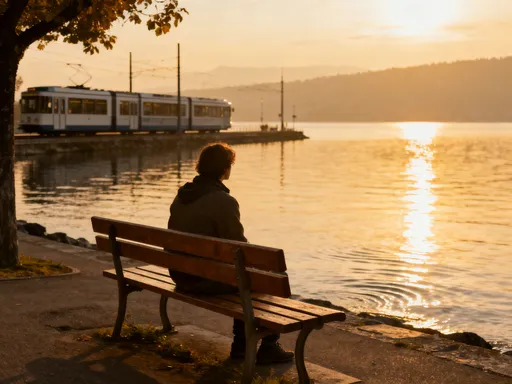
In Geneva, the bench is not just furniture—it’s a philosophy. Scattered throughout the city, these simple seats—some wooden, some iron, some facing the lake, others tucked into shaded groves—are silent invitations to pause. They are the unsung heroes of slow travel, offering a place to rest, reflect, and reconnect. Sitting on a bench in Geneva is not laziness; it’s an act of mindfulness, a deliberate choice to step out of the current and let the world flow around you.
One of the most memorable moments of my week came on a wooden bench near Ile Rousseau, a small island in the Rhône River. I had brought a notebook, intending to write, but instead found myself simply watching. Swans glided past, their necks arched with quiet dignity. A group of schoolchildren laughed as they fed ducks. A cyclist paused to tie his shoe, then waved at someone across the street. The sun warmed the back of my neck, and for the first time in weeks, my mind was still. I didn’t check my phone. I didn’t plan my next move. I just sat.
This is the power of bench culture. It teaches you that travel isn’t only about movement—it’s about stillness. It encourages you to return to the same spot at different times of day, to notice how light changes, how people come and go, how the mood shifts. A bench by the lake at sunrise feels different than at sunset. One in a park at noon holds different energy than in the evening. By revisiting these places, you build a relationship with them, not just a memory.
Choosing the right bench is part of the practice. Look for ones that face something interesting—a view, a fountain, a tree with birds. But also consider comfort and shade. Bring a light sweater, a book, or a journal, but leave distractions behind. The goal isn’t productivity; it’s presence. And sometimes, the best thing you can do for your well-being is nothing at all. In Geneva, the bench is not a pause button—it’s a reset.
Moving Through the City: Public Transport as Part of the Experience
In most cities, public transportation is a means to an end—an efficient but often stressful way to get from point A to B. In Geneva, it becomes part of the journey itself. The tram lines glide silently through tree-lined avenues, offering views of gardens, fountains, and glimpses of the lake. Buses wind through quiet residential neighborhoods, where laundry hangs from balconies and cats nap on sunlit windowsills. Riding without urgency—window-gazing, listening to conversations in French, watching the city unfold—deepens your connection to the place.
The cleanliness and punctuality of Geneva’s transit system add to the sense of calm. Trams arrive exactly when scheduled, seats are clean, and passengers speak in low voices. There’s no rush, no jostling, no need to fight for space. Even during peak hours, the atmosphere remains relaxed. This reliability allows you to travel without anxiety, to ride without checking your watch, to enjoy the ride as much as the destination.
One of the most peaceful experiences I had was taking Tram 15 from the city center to the outskirts. The route passes through leafy suburbs, past schools and playgrounds, alongside streams and small parks. I sat by the window, notebook in hand, jotting down observations: a woman watering flowers, a dog chasing a ball, a street sign in both French and English. No one rushed. No one stared. I felt invisible in the best way—free to observe, to think, to breathe.
The GA Travel Card, provided by many hotels, makes this seamless. It grants unlimited access to trams, buses, and even boats on the lake, removing the stress of tickets and transfers. With this freedom, you can ride without purpose, exploring neighborhoods you might otherwise miss. You can take the same route at different times, noticing how light and life change. Public transport, in Geneva, isn’t just functional—it’s contemplative. It turns movement into meditation.
Why This Matters: Public Spaces as Emotional Anchors
In a world that glorifies speed, productivity, and constant connectivity, Geneva’s public spaces offer something revolutionary: the right to rest. They are not just physical locations; they are emotional anchors, places where stress dissolves and awareness sharpens. Studies have shown that access to green spaces reduces anxiety, improves mood, and enhances cognitive function. In Geneva, these benefits are built into the urban fabric, available to residents and visitors alike.
But beyond the science, there’s a deeper truth: cities designed for lingering create deeper human connections. When you sit in a park and watch children play, when you share a smile with a stranger on a bench, when you hear the same street musician day after day, you begin to feel a sense of belonging. You’re not just passing through—you’re part of the rhythm. This kind of cultural intimacy is rare in modern travel, where experiences are often transactional and fleeting.
Geneva proves that the best travel memories aren’t made in museums or restaurants, but in moments of quiet presence. The smell of wet grass after rain, the sound of a distant church bell, the warmth of sun on your face as you sit by the water—these are the impressions that stay with you long after you’ve returned home. They form a kind of emotional souvenirs, more valuable than anything you could pack in a suitcase.
And perhaps most importantly, Geneva reminds us that slowing down is not a luxury—it’s a necessity. In a life filled with deadlines and distractions, the ability to pause, to breathe, to simply be, is essential for well-being. The city doesn’t force this pace; it gently invites it. Its benches, parks, and promenades are not just amenities—they are acts of care, designed to restore balance in a fast-moving world.
Geneva teaches you to travel not by how much you see, but by how deeply you stay. Its public spaces—simple, accessible, unshowy—become companions on a quieter journey. In a world obsessed with speed, choosing to sit, watch, and breathe is revolutionary. Maybe the best souvenirs aren’t things you pack, but moments you let unfold.