You Won’t Believe These Hidden Gems in Phnom Penh
Phnom Penh isn’t just Cambodia’s bustling capital—it’s a city of quiet surprises. Beyond the traffic and temples, I discovered serene riverside walks, colonial architecture drenched in golden light, and local markets where flavors explode with every bite. If you think you know Phnom Penh, think again. This is about real moments, not tourist checklists. Let me show you how to see the city like someone who’s wandered its corners and fallen in love. With its layered history, vibrant street life, and unexpected pockets of calm, Phnom Penh rewards those who look beyond the surface. This guide will help you experience the soul of the city—one thoughtful step at a time.
Why Phnom Penh Deserves More Than a Stopover
Too often, travelers treat Phnom Penh as a brief layover between Siem Reap’s temples and Sihanoukville’s beaches. They arrive late, depart early, and miss the rhythm of a city that pulses with quiet resilience. But spending just two to three days here transforms the journey, offering a deeper understanding of Cambodia’s past and present. This is not a city of monuments frozen in time, but one alive with movement—children laughing on bicycles, monks in saffron robes walking barefoot on sun-warmed sidewalks, and the ever-present hum of moto engines weaving through narrow streets.
The sensory experience begins the moment you step outside. At dusk, the air carries the scent of grilled pork skewers, coconut pancakes, and charcoal smoke from roadside kitchens. Along the riverbanks, families gather to escape the day’s heat, while street vendors pass out cold sugarcane juice in plastic bags with straws. The city’s energy is palpable, yet it never feels overwhelming. There’s a balance here—between chaos and calm, tradition and modernity—that reveals itself only to those who stay long enough to listen.
Phnom Penh’s historical layers are equally compelling. Once known as the “Pearl of Asia” for its French colonial elegance and tropical charm, the city endured decades of hardship but has emerged with quiet dignity. Today, it honors its past without being defined by it. From the echoes of Khmer classical music drifting from open windows to the careful restoration of 1920s villas, there’s a sense of renewal in the air. By choosing to linger, travelers gain more than sights—they gain perspective.
Moreover, Phnom Penh serves as a cultural bridge. It’s where rural traditions meet urban innovation, where elders sip strong coffee at sidewalk tables while teenagers tap away on smartphones in air-conditioned cafés. This duality makes the city uniquely rewarding for visitors seeking authenticity. Rather than chasing checklists, consider embracing a slower pace. Let the city guide you. You’ll find that Phnom Penh doesn’t demand your attention—it earns it.
Starting Right: The Royal Palace & Silver Pagoda – Beauty with Boundaries
No visit to Phnom Penh feels complete without stepping into the serene world of the Royal Palace. With its golden spires reaching skyward and intricate mosaics shimmering under the sun, the complex stands as a symbol of national pride and spiritual continuity. The main structure, the Throne Hall, dazzles with its ornate roofs and detailed carvings, while the Silver Pagoda—named for the 5,000 silver tiles covering its floor—houses sacred relics, including a life-sized gold Buddha studded with thousands of diamonds. The emerald Buddha, small yet profoundly revered, draws quiet contemplation from visitors of all backgrounds.
Yet for all its visual splendor, the Royal Palace carries a certain emotional distance. Guarded by uniformed attendants and enclosed by high walls, it feels more like a preserved treasure than a living space. Photography is permitted in most outdoor areas, but visitors must remain respectful—no pointing, loud voices, or stepping off designated paths. The experience is best approached with reverence, not just curiosity. Dressing modestly—covering shoulders and knees—is not only required but also a gesture of cultural respect. Lightweight scarves or shawls are useful for women, especially during warmer months.
To avoid the midday heat and crowds, aim to arrive shortly after opening, around 8:00 a.m. The morning light softens the palace’s golden rooftops, casting long shadows across manicured lawns and lotus ponds. This is also the best time for photography, with fewer people and a peaceful atmosphere. As you walk through the courtyards, notice how the river breeze drifts through the open pavilions, offering a gentle contrast to the city’s usual intensity.
Nearby, along the river-facing gardens, quiet benches invite brief pauses. From here, you can admire the Tonlé Sap River as boats glide past and the city slowly wakes up. While the palace itself may feel formal, these peripheral spaces offer moments of connection. They remind us that even the most regal places exist within a living city, shaped by the people who move around them every day. The Royal Palace is not just a monument—it’s a quiet witness to Phnom Penh’s enduring spirit.
A Walk Along the Tonlé Sap: Where Locals Live and Breathe
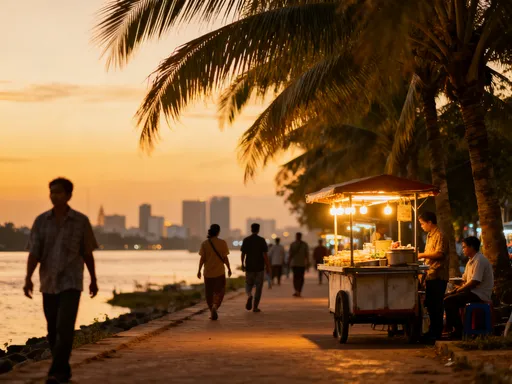
For a more intimate sense of Phnom Penh, nothing compares to a riverside stroll along the Tonlé Sap. This stretch, especially from the Independence Monument to the Japanese Friendship Bridge, is where the city reveals its daily heartbeat. Mornings begin with tai chi practitioners moving in slow unison near the water’s edge, their movements mirroring the gentle flow of the river. By late afternoon, couples appear, walking hand in hand as the sky turns amber and pink. As darkness falls, food carts emerge like fireflies—each one a small universe of flavor and warmth.
Walking this path allows you to experience the city as locals do. There’s no rush, no agenda—just the pleasure of being present. Benches line the promenade, perfect for pausing with a drink or simply watching the world go by. Children chase each other near playgrounds, while older residents sip sweet iced tea and chat under shaded pavilions. The air carries a mix of scents: grilled bananas wrapped in foil, spicy papaya salad, and the occasional whiff of river mist. It’s a sensory mosaic that changes with the hour.
One of the joys of this walk is discovering the small vendors who set up shop after sunset. Grilled corn brushed with chili and lime, skewers of marinated chicken, and bowls of warm noodle soup appear with remarkable consistency. These aren’t tourist stalls—they’re neighborhood fixtures, frequented by families and office workers alike. Buying a snack here isn’t just about eating; it’s a quiet act of participation. You’re not observing culture—you’re part of it.
Along the way, open-air cafés with string lights and cushioned seating offer a chance to rest. Many serve strong Cambodian coffee, brewed dark and sweet, or fresh coconut water straight from the shell. Sitting here, listening to soft music and the distant hum of the city, you begin to understand why locals cherish this space. It’s not just a walkway—it’s a sanctuary. In a city that never fully sleeps, the riverfront offers moments of stillness, connection, and quiet joy.
Hidden Courtyards & Colonial Echoes in the Old Quarter
Just beyond the riverfront’s energy lies Phnom Penh’s Old Quarter—a network of quiet streets where French colonial architecture lingers like a half-remembered dream. Pastel-colored buildings with shuttered windows, wide verandas, and peeling paint stand side by side with modern shops and motorbike repair stalls. These structures, built in the early 20th century, speak of a different era—one of wide-brimmed hats, slow afternoons, and tropical elegance. Though many have fallen into disrepair, their beauty persists in the arches, iron railings, and high ceilings that survive.
The best way to explore this area is without a map. Let curiosity guide you. Turn down alleys, pause at open gates, and look for signs of life within forgotten courtyards. Some buildings have been restored into boutique cafés, bookshops, or small art galleries. One might house a quiet coffee shop where the smell of beans blends with the scent of old wood. Another could be a community space hosting photography exhibits or poetry readings. These repurposed villas are not museums—they’re living spaces, adapting to the city’s rhythm.
Photographers and wanderers will appreciate the textures here: weathered paint, rusted gates, and vines climbing stone walls. Light filters through tall trees, casting dappled shadows on cracked sidewalks. In the late afternoon, golden hour transforms the facades, making them glow with a warmth that feels almost nostalgic. These are not picture-perfect postcards, but moments of urban poetry—beauty found in imperfection.
One real example is a restored villa near Street 240 that now operates as a quiet café with a reading nook and garden seating. Another is a former residence turned artist collective, where local painters display works inspired by Cambodian life. These spaces are low-key, rarely advertised, and best discovered by chance. They represent a growing movement to preserve Phnom Penh’s architectural heritage while giving it new purpose. By supporting such places—whether through a coffee purchase or quiet visit—travelers contribute to a story of renewal.
Escaping the Heat: Green Oases in the Urban Jungle
Phnom Penh’s tropical climate can be intense, especially between 11 a.m. and 3 p.m. For relief, the city’s green spaces offer essential respites. Among them, the Preah Norodom Botanical Garden stands out—a peaceful retreat with wide lawns, towering trees, and the soft chirping of birds. Though not as manicured as parks in other capitals, its charm lies in its simplicity. Paths wind beneath canopies of rain trees and frangipani, creating pockets of shade where readers, families, and solo wanderers find calm.
The garden is especially lovely in the late afternoon, when the sun slants through the leaves and the air cools slightly. Benches are limited, so bringing a lightweight mat or towel allows for a spontaneous rest. Parents bring children to play, while elderly couples walk slowly along the perimeter. There’s no commercial hustle here—just the quiet joy of being outdoors. A small pond with lotus flowers adds to the serenity, often visited by dragonflies and the occasional kingfisher.
Another green haven is the shaded area around Wat Phnom, the hilltop temple that gave the city its name. While the temple itself draws visitors, the surrounding grounds are often overlooked. Tall trees provide deep shade, and stone paths lead to quiet corners where incense smoke drifts from small offerings. It’s a place for reflection, not just sightseeing. Arriving in the late afternoon allows you to enjoy the cool air while avoiding the midday sun and larger tour groups.
These green spaces are more than decorative—they serve as mental resets. In a city full of motion, they offer stillness. They remind travelers that rest is not wasted time, but a necessary part of exploration. By planning short visits to such oases, you preserve your energy and deepen your experience. And with bottled water or fresh coconut juice available nearby, staying hydrated is easy. In Phnom Penh, nature doesn’t compete with the city—it complements it.
Sunset at Vattanac Capital Sky Deck – Worth the Wait?
For panoramic views of Phnom Penh, the Vattanac Capital Sky Deck is the highest public vantage point in the city. Located on the 32nd floor of a modern skyscraper near the river, it offers a sweeping perspective of the skyline—old pagodas beside glass towers, the winding Tonlé Sap, and the distant hills of Kandal Province. The elevator ride itself feels like a transition, lifting you from street-level chaos to a realm of quiet observation.
The best time to visit is just before sunset. As the sun dips below the horizon, the city lights begin to flicker on, and the river takes on a golden glow. From above, you can trace the flow of traffic, spot rooftop gardens, and see how the city is expanding outward. The contrast between historic neighborhoods and new developments becomes strikingly clear. It’s a moment of perspective—both literal and metaphorical.
That said, the experience isn’t flawless. Access can be inconsistent. Some days, the sky deck is open to the public with a small entry fee; other days, it’s reserved for private events or closed without notice. Crowds can gather during peak hours, and the commercial atmosphere—complete with a café and gift shop—can feel at odds with the tranquility of the view. There’s no outdoor balcony, so photos are taken through glass, which may reflect interior lights.
Still, for those seeking a bird’s-eye view, it’s worth attempting. If entry is denied, alternatives exist. Rooftop bars like Eclipse or Sora Sky Bar offer similar vistas, often with more comfort and better drinks. While they come at a higher cost, they provide a relaxed setting to watch the city transition from day to night. Whether from a formal sky deck or a quiet rooftop lounge, seeing Phnom Penh from above adds depth to your understanding of its scale and spirit.
How to Move Like a Local: Transport, Timing, and Tiny Joys
Navigating Phnom Penh becomes easier once you adopt a few local habits. Tuk-tuks are the most common form of transport, but it’s essential to agree on the price before starting your journey. Drivers rarely use meters, so clarity prevents misunderstandings. For short distances—under two kilometers—walking is often the best choice. It allows you to notice details: a flower blooming in a cracked wall, the sound of a street musician’s flute, or the aroma of fresh bread from a corner bakery.
Timing matters. Mornings are ideal for sightseeing, when the air is cooler and streets are less congested. Between 10 a.m. and 3 p.m., the heat intensifies, making indoor visits—museums, cafés, or shopping arcades—more comfortable. Evenings belong to the riverfront, where temperatures drop and the city lights create a gentle ambiance. Planning your day around these rhythms makes exploration more enjoyable and sustainable.
Don’t overlook the small pleasures. An iced coffee from a street stall, sweetened with condensed milk, can be a moment of pure delight. Fresh sugar cane juice, pressed on the spot and served over ice, is both refreshing and affordable. These simple indulgences aren’t luxuries—they’re everyday joys that locals cherish. By embracing them, you connect more deeply with the city’s culture.
Finally, remember that the best experiences often happen between destinations. It’s the quiet alley with a mural, the elderly woman selling lotus flowers by the temple gate, or the spontaneous laughter of children playing near a fountain. Phnom Penh reveals itself not in grand gestures, but in these fleeting, authentic moments. Travel slowly. Stay curious. And let the city surprise you—not with spectacle, but with sincerity.